
Discover the first website in the world, created by Tim Berners-Lee in 1991 at CERN. Learn its history, purpose, and impact on the web.
What Is the First Website in the World?
The first website in the world was created by British computer scientist Tim Berners-Lee in 1991. It was hosted on a computer at CERN, the European Organization for Nuclear Research, located in Geneva, Switzerland.
The website’s address was:
It went live on August 6, 1991, and it explained what the World Wide Web was and how people could use it.
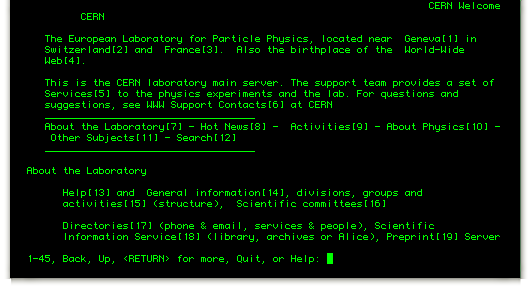
Image of the First Website

Who Created the First Website?
The first website was created by Tim Berners-Lee while working at CERN.
He invented:
- World Wide Web
- HTML (HyperText Markup Language)
- HTTP (HyperText Transfer Protocol)
- The first web browser called WorldWideWeb
His goal was simple:
To help scientists share information easily across different computers around the world.
Why Was the First Website Created?
Before the web, scientists shared information using emails and file transfers. There was no simple way to connect documents across computers.
Tim Berners-Lee proposed a system using hypertext. In 1989, he wrote a proposal titled “Information Management: A Proposal.” This idea became the foundation of the modern internet’s web system.
The first website explained:
- What the World Wide Web is
- How to create web pages
- How to set up a web server
- How to use a web browser
It was basically a guide to building websites.
What Did the First Website Look Like?
The first website was very simple:
- Only plain text
- No images
- No colors
- No design layout
- Just hyperlinks and information
It looked like a basic document with blue clickable links.
Compared to today’s modern websites with videos, animations, and interactive features, it was extremely basic.
Technical Details of the First Website
Here are some important technical facts:
| Feature | Detail |
|---|---|
| Creator | Tim Berners-Lee |
| Year Created | 1990 (public release in 1991) |
| First Public Access | August 6, 1991 |
| Hosted At | CERN, Switzerland |
| Web Address | http://info.cern.ch |
| Computer Used | NeXT Computer |
| Language Used | HTML |
| Protocol Used | HTTP |
The website was hosted on a NeXT computer, which had a label saying:
“This machine is a server. DO NOT POWER IT DOWN.”
Difference Between the Internet and the First Website
Many people think the internet and the first website are the same. They are not.
- The internet existed before 1991.
- It began in the late 1960s as ARPANET.
- The World Wide Web was built on top of the internet.
The internet is the infrastructure.
The web is a system that runs on it.
When Did the Web Become Public?
In 1993, CERN made the World Wide Web technology free for everyone to use.
This decision allowed developers worldwide to create websites without paying fees. That is one of the main reasons the web grew so quickly.
Is the First Website Still Available?
Yes.
A restored version of the first website is still available online through CERN archives.
It shows the original text-based design and helps people understand how simple the early web was.
Impact of the First Website on the Modern World
The first website changed everything. Today, the web powers:
- Online education
- E-commerce
- Social media
- News platforms
- Blogging
- Digital marketing
- Cloud computing
- Streaming services
From one simple page in 1991, the web has grown to billions of websites.
Interesting Facts About the First Website
- It had no images.
- It was mainly informational.
- It explained how to create other websites.
- It was hosted on a single computer.
- The World Wide Web became free in 1993.
- Tim Berners-Lee did not patent the web.
Why the First Website Matters Today
The first website represents:
- Innovation
- Open knowledge sharing
- Free access to information
- The beginning of the digital era
Without that simple page, modern digital life would not exist as we know it.
Timeline of Important Events
| Year | Event |
|---|---|
| 1989 | Proposal for World Wide Web |
| 1990 | First website created |
| 1991 | Website made public |
| 1993 | Web made free for public use |
Conclusion
The first website in the world was info.cern.ch, created by Tim Berners-Lee at CERN in 1991. It introduced the World Wide Web and changed the way humans share information.
It was simple. It had no images or design. But it started a digital revolution.
Today, billions of websites exist because of that first page.
From a single server in Switzerland to a global network connecting billions — that is the power of the first website.
Frequently Asked Questions (FAQ)
1. What was the first website in the world?
The first website was info.cern.ch, created in 1991. It explained what the World Wide Web was and how to use it.
2. Who created the first website?
It was created by Tim Berners-Lee while working at CERN.
3. When was the first website launched?
The website became publicly accessible on August 6, 1991.
4. What was the purpose of the first website?
Its purpose was to share information about the World Wide Web and guide people on how to create web pages and servers.
5. Is the first website still available?
Yes, a restored version is still available through CERN’s archives.